26 June 2025
It was all hands-on deck recently when students at Heathridge Primary School begun planting their new Miyawaki pocket forest.
With the assistance of Dr Grey Coupland from Murdoch University and the Harry Butler Institute, the students started repurposing a neglected area of bush outside their school.
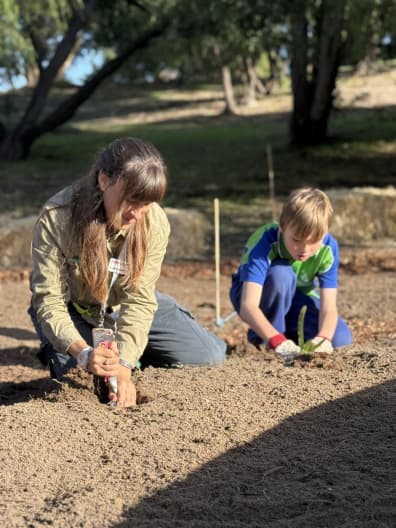
Dr Grey Coupland helped students to plant the new trees.
The new garden will feature more than 200 native plants, a yarning circle, six season Noongar flower beds and a cockatoo trough, and turn the space into a living classroom that encourages the native flora and fauna to flourish.
Principal, Denise Pires is grateful to the Harry Butler Institute, at Murdoch University, for supporting the scientific research behind the project and to Carbon Positive Australia for backing the program and making it accessible for schools.
“This initiative has become so much more than a planting project,” Ms Pires said.
“It has become a living learning space, an outdoor classroom where students can engage directly with nature, understand ecosystems, learn about biodiversity and feel empowered to be part of real environmental action.”
Heathridge Primary School became the 17th school to join the Miyawaki Forest program, that aims to bring environmental action and STEM learning into schools through the planting of compressed mini forests, ideal for rapid greening of urban environments.
Leading the project is Dr Coupland, whose team from Murdoch University works with each school to assist students with the planting, care and maintenance of the forests, until they’re ready to take care of it on their own.
“When they first plant and they come out to do monitoring with us, they’re always checking for their plant and seeing how their plant is growing,” Dr Coupland said.
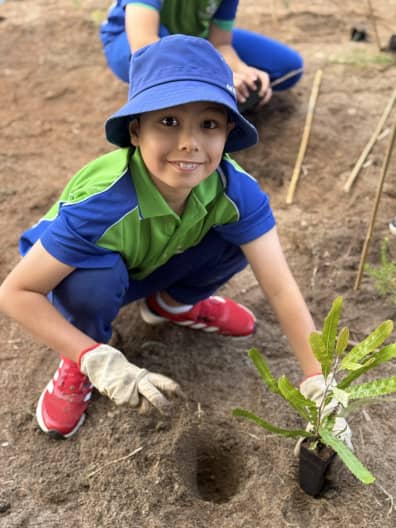
Heathridge Primary School is the 17th school to join the Miyawaki Forest program.
“As we go on through the program, they start off seeing their plant in the forest, and then after a few months they start looking bigger and they start seeing the forest.
“Then they start seeing all the animals and it becomes a holistic thing. Then you feel the energy coming from them that they’ve done something significant, they’ve contributed to their local environment, they’ve restored biodiversity and they’re restoring an endangered plant community.
“Their efforts are making a really big difference.”
The sustainability journey began at the school when a composting system was established earlier this year. That success has already attracted the attention of ABC's Gardening Australia program, who visited the school in May to learn more about their superior compost.
Year 6 student, Kaycian Bailey, is a member of the school’s sustainability leadership group and was one of four students to take the Gardening Australia team through the school’s composting process.
“The compost is very important for the garden,” Kaycian said, acknowledging the contribution from the whole school to revitalise their food waste,
“Room 9 has helped us, me and Byron always take out the buckets and they always have a lot of fruit in them that we chuck into the compost.”
When asked about the secret to their compost's success, Kaycian enthusiastically shared, “coffee grounds and coconut fibre!”
More details about the Miyawaki Forest program are available at Pocket Forests WA.