STEM in early childhood
The experiences children have during the early years are extremely important. As your child’s first teacher, your role is vital in creating opportunities that promote learning in a fun and safe environment.
You can help your child by creating a home environment that fosters curiosity and questioning through play.
You can help introduce key STEM skills by teaching them to:
- ask questions
- work together
- think creatively
- solve problems
- explore and take calculated risks
- test solutions to problems
- discover new ways of doing things.
There are lots of exciting things you can do at home or when you are out, making learning enjoyable for everyone.
By encouraging your child to ask questions, you are allowing them to take an active role in their own learning and helping them understand the world around them.
When children ask questions, they are developing their critical thinking skills and building their STEM capabilities. When they ask Why? try to not provide the answer. Instead, respond with alternative questions and ideas, and encourage them to search for answers and solutions themselves.
We have created a resource that is full of activities you and your child can do together to help them develop valuable STEM skills.
Parent resource
Parent resource
-
Exploring STEM at home
Activities and ideas for parents to support their children’s learning and development.
english
You may also be interested in
返回 What is STEM?
STEM is an approach to learning and development that integrates the areas of science, technology, engineering and mathematics.
Through STEM, students develop key skills including:
- problem solving
- creativity
- critical analysis
- teamwork
- independent thinking
- initiative
- communication
- digital literacy.
Why is STEM important?
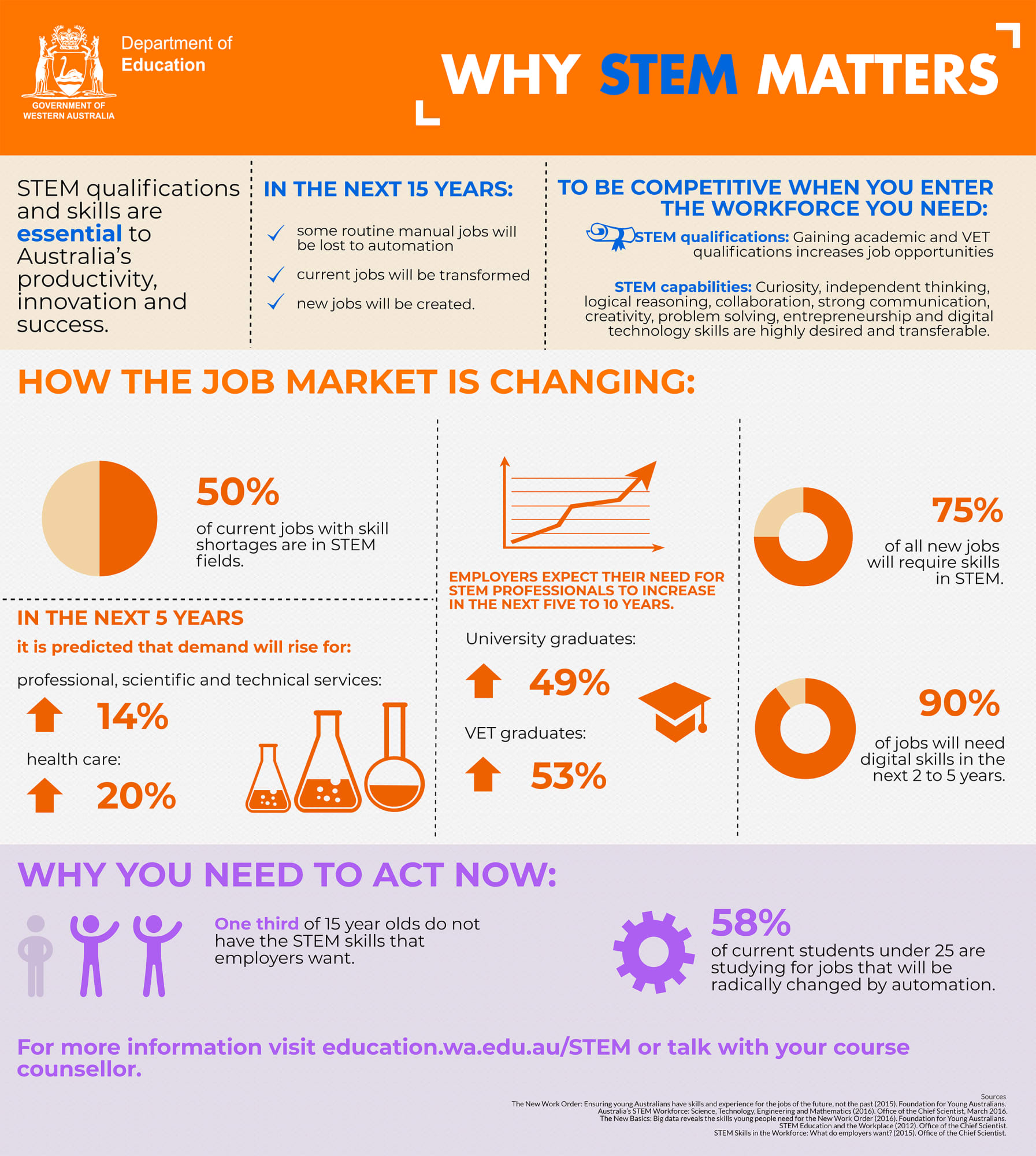
The global economy is changing. Current jobs are disappearing due to automation and new jobs are emerging every day as a result of technological advances.
The continual advances in technology are changing the way students learn, connect and interact every day. Skills developed by students through STEM provide them with the foundation to succeed at school and beyond.
Employer demand for STEM qualifications and skills is high, and will continue to increase in the future. Currently, 75 per cent of jobs in the fastest growing industries require workers with STEM skills. To be competitive, the Australian workforce needs people who can adapt to a changing workplace.
STEM empowers individuals with the skills to succeed and adapt to this changing world.