Students will travel to Darwin and Singapore in April 2026.
Accompanied by 3 supervisors, the group of 10 students will depart for the 9-day tour in the April school holidays.
The unique 2026 program gives students an opportunity to investigate the Anzac legacy and those who served in the armed forces in all wars. They will commemorate the 81st anniversary of the end of World War ll, the 84th anniversary of the bombing of Darwin and the 84th anniversary of the fall of Singapore.
This annual competition is open to all Western Australian students in Years 8 to 11. Students from public and non-government schools can submit their entries for the chance to be selected as ambassadors for the tour.
Students are selected following a written submission and interviews, demonstrating their interest in Australian history and an understanding of the Anzac legacy.
Since 2004, 276 students have been selected to tour and travel to Belgium, England, France, Greece, Malaysia, Singapore, Turkey, Vietnam, Japan and destinations across Australia to commemorate the service and sacrifice of Anzac men and women.
- Tour diary, day 9
- Tour diary, day 8
- Tour diary, day 7
- Tour diary, day 6
- Tour diary, day 5
- Tour diary, day 4
- Tour diary, day 3
- Tour diary, day 2
- Tour diary, day 1
- Tour Participants
Day 9 by Lucy Henville, Year 10, Mount Lawley Senior High School, Maya Gallegos, Year 10, Collie Senior High School, Josiah Simmons, Year 11, Hedland Senior High School and Amy Newton-Norris, Year 12, John Curtin College of the Arts.
Lucy Henville
By the time the sun rose, I already felt sad to be leaving behind Singapore and all that we had learnt there. As we made our way to Changi Airport, I reflected on the meaningful 9 days we had just experienced. Hearing personal accounts of war and seeing firsthand the resilience of the people of Darwin as they rebuilt their community after such devastation was incredible.
 Throughout the tour and pre-tour, we held 4 ceremonies to commemorate the legacy of the Anzac soldiers, the military who fought in Singapore and the civilians who suffered war crimes. These ceremonies made me pause and truly consider what their lives would have been like, standing on the very soil where they endured such hardship only 80 years ago. I thought of the families, young children and servicemen who were separated from their loved ones, many of whom were never given the chance to say goodbye, and the anxiety and heartbreak this would have caused thousands of victims of war. The strength and bravery shown by people living through times of conflict are almost incomprehensible, and for this reason, I believe stories like these must be remembered so that we can learn from the past and work to ensure such atrocities never happen again.
This tour has been an unforgettable, truly once-in-a-lifetime experience. I will continue to carry with me the valuable lessons I have learned about conflict, commemoration and the importance of preserving memory, along with a deep appreciation for how fortunate we are to live in peacetime today.
Maya Gallegos
Our time in Singapore treated us well, although the weather was very hot and humid, the historical sites we visited and the diverse range of food made it all worthwhile. My favourite place to visit was Kranji War Cemetery, as it was a surreal experience to see the graves of so many individuals, people who had lives, jobs and families back home. They were people who were deeply missed when they passed, having sacrificed their lives for the freedom of their nation.
As I researched Albert Barnett Facey, I discovered that his father was the well-renowned author of 'A Fortunate Life'. His father wrote about how profoundly his son’s death affected him. Gaining insight into one specific story made me reflect on the countless other stories buried within the cemetery and how, while some will be remembered forever, like Facey’s, many acts of heroism will gradually fade into the background. This is why the tour is so important: it helps ensure that the stories of countless soldiers continue to live on and that they are properly commemorated for their service.
 Josiah Simmons
Overall, the tour has been a powerful experience, educating each of us about the defence of both Darwin and Singapore while providing an in-depth narrative of the Japanese attempts to invade during the Second World War and the significant loss of life on both sides that followed. The tour also equipped us with meaningful ways to commemorate those who lost their lives, a skill we will need to carry forward in the coming weeks and months as we share our experiences with the public and remind others of the cost of the peace we enjoy today.
Amy Newton-Norris
I’ve had so much fun this trip and made so many amazing memories. We have had the pleasure of finding lifelong friendship and a never-ending pool of knowledge.
When I first applied for the tour, I expected it to be a fun and interesting experience. By the end, my perspective had completely shifted, and I came to understand just how life-changing this opportunity truly was. While I will miss both the experience and the people I met, I feel incredibly grateful to have been part of it and to have shared it with them.
From moving commemoration ceremonies to enjoyable activities, this trip offered a perfect balance that made it truly unforgettable. I originally applied to walk in my Pop’s footsteps in Darwin, something I feel I have more than achieved. Singapore then opened my eyes to an entirely new side of war history, one I previously knew little about, and now I could speak for days about everything I have learned.
Day 8 by Josiah Simmons, Year 11, Hedland Senior High School, Shylah Broux, Year 11, Shenton College, and Lucy Henville, Year 10, Mount Lawley Senior High School.
Josiah Simmons
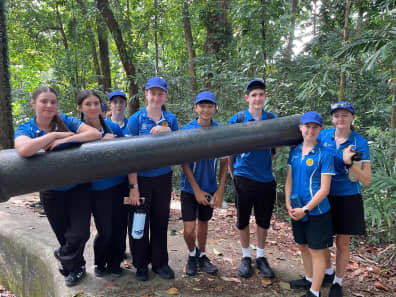
At the start of our last full day, we headed to Labrador Park on the south side of Singapore. The park is named after Labrador Villa, built in 1881 by George John Mansfield, and contains many concrete military structures and remnants of former gun emplacements that have endured into the 21st century. Also known as Fort Pasir Panjang, meaning 'long beach' in Malay, the site was prepared to defend Singapore against a potential Japanese invasion. At the time, the British believed the Japanese would not advance through the jungle and instead expected an attack from the sea.
 Shylah Broux
As we walked around the historical site, we also ventured off the main paths into the surrounding bush to better understand what Allied soldiers across Singapore might have experienced. The jungle was extremely dense, making it difficult to see far ahead, so soldiers often had to rely on other senses, such as hearing. Japanese forces were able to exploit this by creating noise to draw attention in one direction before attacking from another, taking advantage of limited visibility and blind spots.
Lucy Henville
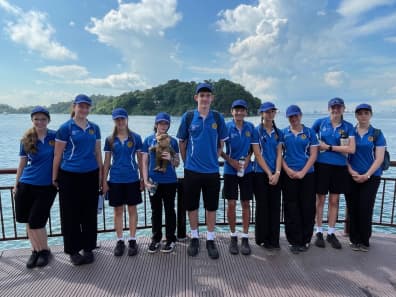
From the park, we then enjoyed a classic tourist experience, riding the Mount Faber cable car across to Sentosa and visiting Fort Siloso to view the coastal batteries from the opposite side of the harbour. The preservation of the bunkers, guns and lookout positions was impressive. One section of the museum installation that resonated deeply with me was the Surrender Chambers, which used lifelike wax figures to recreate both the British surrender to Japan in 1942 and the Japanese surrender to the Allies in 1945.
Our tour guide, Joseph, shared a story about Lieutenant-General Tomoyuki Yamashita, the Japanese commander in Malaya, explaining that Yamashita did not personally sign the Japanese surrender documents in Singapore, a role carried out instead by General Seishirō Itagaki. According to the guide, this reflected the deep shame associated with surrender in Japanese military culture at the time. These attitudes were rooted in Bushidō ethics, the Senjinkun code, and the belief in the Emperor’s divinity, which promoted the idea that surrender was dishonourable and often resulted in extremely high casualty rates due to the expectation to fight to the death rather than surrender.
 Shylah Broux
Next, we visited Adam Park, where we saw the distinctive black-and-white houses that are owned by the government. While the exteriors of these houses must remain unchanged, the interiors can be renovated, and owners are permitted to add features such as swimming pools or tennis courts. This is similar to heritage-listed homes in Perth. Many of these properties are purchased by wealthy foreigners rather than locals, largely because the area is some distance from train stations and markets. Standing there, it was striking to imagine that what is now a quiet street was once the site of fierce combat between Japanese and Allied forces.
Lucy Henville
Our final historical site was one of Singapore’s reservoirs, which today is used for recreational activities such as kayaking but was once a key battleground in what became known as the ‘Battle for Water,’ a campaign that ultimately contributed to the British surrender. Over the course of the day, I learned that while the British were critically short of water supplies, the Japanese army, despite projecting an image of being unstoppable, was also running low on ammunition at the time of the surrender. Looking out over the reservoir, I wondered how many lives might have been spared, or how much further suffering the civilians of Singapore might have endured, had the British been aware of ‘Yamashita’s bluff’ and chosen to continue fighting.
I keep replaying one moment from today where I looked out across the harbour from Fort Siloso in Sentosa to mainland Labrador Park and imagined the small canoes of Operation Jaywick, bobbing along in the darkness, about to complete a crucial mission. It was fascinating how calm, serene and well-kept the memorial and information site was in modern times, when, just 80 years earlier, the exact spot had been riddled with chaos, battle and blood.
Day 7 by Zach Lentin, Year 10, Wesley College.
Today we visited Kranji War Cemetery, which contains nearly 4,500 Commonwealth soldiers’ graves, as well as the Singapore Memorial, which is dedicated to more than 24,000 casualties of the Commonwealth land and air forces who fought in South-East Asia and have no known grave. The atmosphere was unlike anything I have experienced before. It was incredibly touching and solemn, and it really allowed me to appreciate the commemoration of Australian servicemen and women, no matter their religion, cause of death, age, or occupation. It was a very humbling sight, where every gravestone had a story behind it, and showing how families and communities had been deeply impacted by the war. Seeing the thousands of graves helped me understand the heartbreak endured, and the suffering that continues to affect many people today.
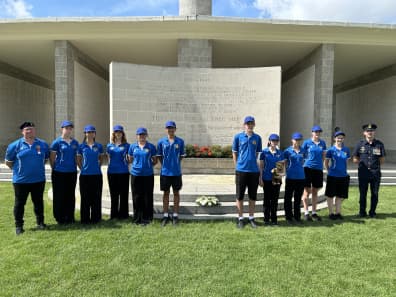 At the cemetery, we were greeted by Squadron Leader James Ralph, a member of the Australian Defence Force stationed with the Australian High Commission in Singapore. He guided us to several graves of soldiers researched by members of our group. One such grave was that of Corporal C.M. Stewart from Z Force, who was killed alongside several others during the ill-fated Operation Rimau. Short presentations were delivered, and poppies were laid on the graves of Sergeant Richard Newell Fitzpatrick and Private Albert Barnett Facey.
Three members of our group then led a wreath-laying ceremony, giving us time to honour the fallen. This was a deeply moving experience and allowed for quiet reflection and respect.
The Former Ford Factory museum was another highlight of the day. We followed our tour guide, George, into one of the most significant World War II landmarks in Singapore. This is the actual site where negotiations for the British surrender took place—an event remembered as one of the lowest points in British military history, when Lieutenant-General Arthur Percival surrendered over 80,000 troops to a much smaller Japanese force. Learning about how the surrender unfolded, including incidents such as the deliberate dropping of the white flag in defiance of Japanese media, was fascinating. This experience greatly enhanced our understanding of the events in Singapore and provided valuable insight into how and why they unfolded as they did.
 We also travelled to the north-west coastal area of Singapore, where the 2/4th Machine Gun Battalion, formed with men from Western Australia, faced the Japanese invasion. It was striking to see how close Singapore is to Malaysia. We then travelled on to Bukit Timah, where two of the soldiers we researched were killed in action. There, we recited both verses of the Ode, honouring the specific wish of the men of the 2/4th Machine Gun Battalion that both verses always be read.
To end our wonderful day, we were fortunate enough to visit Marina Bay. It was a magical experience, which showed how Singapore has transformed into a modern, thriving city. One of my favourite parts of the botanical gardens was watching the light show from the lawn, where the giant artificial trees lit up to some of my favourite classic songs, which was an amazing experience.
Overall, this was one of my favourite days of the tour, and for good reason. Each location we visited contributed to a much deeper understanding of the events that led to the fall of Singapore. I was finally able to clearly organise the information in my mind and understand the sequence of causes and events. I remain deeply grateful for, and appreciative of, the sacrifices made by soldiers and their families during times of war. To commemorate is not only to respect the past, but also to help pave the way for a better future.
Day 6 by Henriette Hoger, Year 11, Kolbe Catholic College.
During breakfast this morning, we had the opportunity to meet a group of students from Taiwan. It was a valuable cultural exchange as we spoke with them, helped them practise their English, and learnt about their experiences. It was great to form connections that extended beyond the tour itself.

After breakfast, we walked to Fort Canning, where Eunice guided us through the site’s rich historical landscape. Her engaging explanations brought the past to life as we explored key locations within the park. We learnt about Singapore’s strategic importance and its role in military history, which set a strong foundation for the deeper insights we would gain throughout the day.
Following visits to a couple of sights during our bus ride, we travelled to a local hawker centre for lunch. This quick but enjoyable stop allowed us to experience Singapore’s vibrant food culture while recharging for the afternoon’s activities.
A highlight of the day was our visit to the Battle Box, a former underground command centre that played a critical role during World War II, particularly in the events leading up to the fall of Singapore. Our guide, Jerome, led us through the bunker and carefully explained how decisions were made under immense pressure. Walking through the rooms gave us a strong sense of the tension and uncertainty faced by those involved. This experience deepened our understanding of leadership and the harsh realities of wartime conditions.
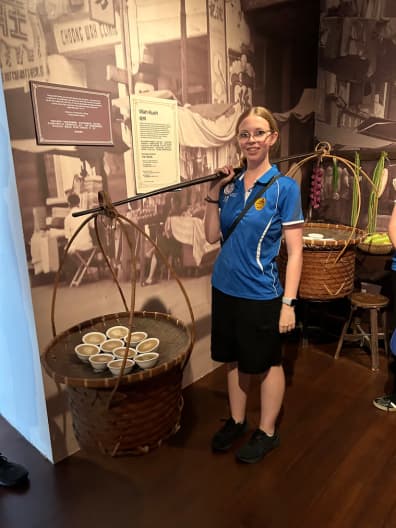 We then visited the Changi Chapel and Museum, where thoughtfully curated exhibits and artefacts provided insight into the experiences of prisoners of war during the Japanese occupation. The stories of resilience, courage, and mateship were particularly moving and resonated strongly with our group. This visit encouraged reflection on the sacrifices made by service personnel and reinforced the importance of remembrance at the heart of the Anzac spirit.
Later, we explored Chinatown through a heritage tour led by Renay. This immersive and engaging experience brought the area’s history, traditions, and daily life to life through his storytelling. His passion and knowledge made this a standout part of the day, helping us appreciate Singapore’s cultural diversity and historical depth. After the tour, we had time to explore the area and do some souvenir shopping, which was a fun way to conclude the visit.
To end the day, we gathered for dinner and reflected on our experiences together. It was a great bonding moment for the group, with many of us trying new food, some even tasting durian for the first time. These shared experiences strengthened our connections and added enjoyment to a day that was also deeply meaningful.
Overall, the day provided a deeper understanding of Singapore’s wartime history. Visiting significant sites such as the Battle Box and Changi Chapel allowed us to connect meaningfully with the past while reflecting on the values of courage, resilience, and remembrance. It was a day that not only expanded our historical knowledge but also reinforced the importance of commemorating those who served.
Day 5 by Bronte McGillivray, Year 12, Lumen Christi College and Adelle Hoddy, Year 11, Western Australian College of Agriculture - Cunderdin.
Bronte McGillivray
Today marked our final day in Darwin. The only activity planned was a tour of HMAS Coonawarra, a Royal Australian Navy base located in the Larrakeyah Defence Precinct. We had already seen the base from the sea the day before.
The tour was organised by my brother, Lochlan, and sister‑in‑law, Halina, who both work and live on the base. We arrived slightly earlier than expected and waited in the sign on bay for our escorts. Fortunately, our passport numbers were already in the system, so signing in was quick and straightforward.
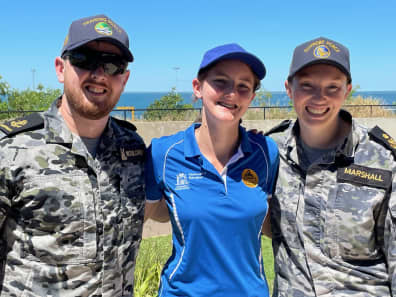 My brother also bought me a hat and some badges, and it was really special seeing both him and Halina on base and in uniform, something I don’t get to experience very often.
We walked down to the boat ramps, where decommissioned and non‑active vessels were being hoisted out of the water, and learnt about the process involved in removing and maintaining them. We also visited Halina’s workplace in the supply chain area, where we saw the offices and warehouses that support base operations.
Before moving further into the base, we received a safety briefing outlining what we were and weren’t allowed to do. We then walked past the docks, where we saw the new class of patrol boats used in Operation Resolute. The vessels we had seen earlier at the ramps were from the older class, which made it interesting to compare the 2.
One of the highlights of the tour was spending an hour in the armoury. During the first half, we were given a detailed tour of the storage area and shown a range of equipment, including new shotguns, binoculars, standard operational weapons and ceremonial arms. It was the perfect opportunity to ask questions, and we learnt a lot about the Navy and the recruitment process.
In the second half of our time there, we were allowed to handle some of the weapons used on patrols, as well as a baton and a mounted machine gun. All weapons were on safety, unloaded, and we were under strict instructions.
Most of our tour was spent in the armoury, so we didn’t get to see everything on the base. However, even the small portion we experienced was incredibly impressive. Everyone agreed that the tour gave us a much better understanding of what goes into protecting Australia’s borders and the significant amount of preparation required for both vessels and crew before each deployment.
After a quick bathroom break, I said goodbye to Lochlan and Halina, and we departed the base, heading to the airport for our next journey.
Adelle Hoddy
After an engaging morning, we made our way to the airport. It was sad leaving Darwin, but we were all filled with excitement as we looked ahead to our next adventure, Singapore. For many of us, including myself, it was our first time travelling overseas.

Following a slight delay, we boarded the plane, eager to discover what Singapore had in store. The flight was mostly smooth, and a sense of excitement seemed to radiate throughout the cabin. We were served a lovely meal and enjoyed the views from our windows before beginning our descent into Changi Airport.
As we approached, I noticed the large number of boats scattered along the coastline, immediately highlighting Singapore’s significance both in modern times and throughout history, particularly during wartime. It was an eye‑opening sight.
After disembarking and collecting our luggage in the very warm airport, we met our tour guide, George, who will be with us for the next 3 days. Stepping outside, we were instantly struck by the intense heat and humidity, which was even stronger than what we had experienced in Darwin, despite it being around 8 pm.
During the drive, George explained local laws and customs, along with an overview of what our tour would involve. From the very beginning, it was clear that he was extremely knowledgeable and passionate. We ended the day enjoying scenic city views on the way to the hotel before settling in for some well‑needed sleep.
Day 4 by Maya Gallegos, Year 10, Collie Senior High School.
Today was a busy day filled with travel and learning, particularly about the Bombing of Darwin from both the sea and the sky. We departed the hotel and headed to the USS Peary Memorial in Bicentennial Park, where one of the ship’s original guns is now displayed.
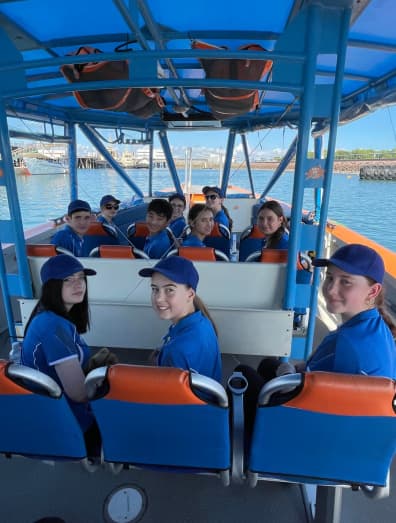 From there, we travelled to Stokes Hill Wharf to participate in the Bombing of Darwin harbour cruise. During the cruise, we explored significant World War II landmarks, including the oil storage tunnels, Stokes Hill Wharf, Fort Hill Wharf, and the wreck site of the USS Peary. Using sonar technology while floating directly above the wreck, we were able to appreciate the sheer size of the ship, which sank in the harbour 84 years ago. We also passed the local Navy base, Larrakeyah (which we will visit tomorrow), and were lucky enough to see some playful dolphins before disembarking.
After the cruise, we visited the Royal Flying Doctor Service (RFDS) Museum, located on Stokes Hill Wharf. The museum provided a comprehensive history of the RFDS and its establishment, along with detailed information about the Bombing of Darwin. The experience was made particularly engaging through a range of immersive displays, including VR experiences and a simulation showing what the bombing would have looked like from the wharf.
We then headed to the nearby food court for lunch, where fish and chips proved to be the most popular choice among our group. After a filling meal, we made our way to Parliament House. Following security checks, we entered the main hall, which was once the site of the old Post Office prior to the bombing. Nine people were killed there during the attack, including the postmaster, his wife and daughter, 6 female telegraphists, and a postal clerk. Another individual was fatally wounded by shrapnel and died 2 days later. A small plaque marks the exact spot where the bomb struck, along with a photograph showing where Mr Mays scraped the bayonet of his rifle against a column during a Bombing of Darwin commemoration ceremony many years later.

Our final stop for the day was the Darwin Aviation Museum, which was my personal favourite. Inside the museum were approximately 20 aircraft used during World War II, as well as a Boeing B‑52G bomber, the only one of its kind in the Southern Hemisphere. After exploring the exhibits and viewing the interiors of several aircraft cockpits, we visited the gift shop to purchase souvenirs.
As this was our final full day in Darwin, we returned to the hotel and said farewell to our tour guide, John. Throughout the trip, he shared valuable insights into World War II and the Bombing of Darwin during our bus rides, along with many interesting and entertaining facts about the region.
Day 3 by Lucy Henville, Year 10, Mount Lawley Senior High School.
It seems crazy to imagine that only 3 days ago, we were eagerly awaiting our travel to Darwin and today we are on day 3 of the tour!
 We have truly settled into the hotel, routine and Darwin, and today was our second entire day of action-packed activities. We embarked on a bus tour, guided by a local Darwin historian named John, to explore numerous historic sites around Darwin, most notably, the Adelaide River War Cemetery, which contained the graves of fallen soldiers that we have researched.
Our first stop was the WWII military base camp named 16 Mile, located along Stuart Highway. To be able to visualise the trenches that once protected the Anzac soldiers from enemy fire (now concealed with shrubs), was impactful as it felt very intimate and real. We began with a short walk through the nature that revealed steel pop-ups of soldiers with guns and radios near the path, giving us a perspective of what it would have been like preparing for the Japanese invasion at the time. Following Stuart Highway, we eventually arrived at Adelaide River War Cemetery. I was initially surprised at how well-kept and modest-sized it was, with many beautiful gardens and a serene atmosphere. Several Western Australian soldiers who lost their lives during the bombing of Darwin and its aftermath had gravestones in the cemetery alongside other soldiers from the Northern Territory and across Australia.
 This visit has been a key takeaway from today, as being able to see first-hand the resting places of people that we had researched felt very close to home. It resonated deeply with me and served as a reminder that every grave has a story and loved ones who were left behind. This knowledge has made me feel especially appreciative of the hard-fought freedoms that we enjoy today.
Travelling by bus, we reached the Strauss airstrip, which is one of the most preserved pursuit fighter installations in Australia and serves as a public memorial to the Allied air defence during the war. The runway also shows life-sized aircraft models made of aluminium cutouts to represent the Kittyhawk and Spitfire aircraft used during the 1940’s.
Our touring of regions up to 150 km away from Darwin further highlighted the influence of Japanese attacks and 77 air raids, which also had a significant broader impact on rural areas outside of the main city. We finished our day with a delicious dinner at Darwin Services Club, where we bonded over shared stories and laughter. In addition, we gained insight from family members of one of the students and their personal connection to the Australian Defence Force over dinner.
Day 2 by Amy Newton-Norris, Year 12, John Curtin College of the Arts.
Our first full day in Darwin was an interesting start to the tour. After a big breakfast down the street, we all headed back to the hotel to get ready for a guided tour with coach driver Denis and historian John.
 The first place we visited was the Darwin Cenotaph in Bicentennial Park. The Darwin Cenotaph holds deep significance, standing not only as a memorial for those who departed from this harbour, but also as a reminder of the resilience and courage shown across the Northern Territory during the Bombings of Darwin in WWII.
We conducted a commemorative address to honour the Anzacs who served throughout many conflicts and operations, including WWI, WWII, Korea, Malaya and Vietnam. We were able to lay a wreath and a poppy at this location. While standing near the harbour, John pointed out landmarks across the water to illustrate where the Japanese would have invaded from, which helped us visualise the intensity of the situation that civilians and soldiers alike experienced in Darwin in the 1940s.
When the first air raid occurred on 19 February 1942, the citizens of Darwin received no warning, initially believing the planes to be American aid. By 1943, Darwin had been subjected to 77 air raids.
We then took the coach to Charles Darwin National Park, where we explored a weapons storage bunker that had been converted into a small exhibit.
Our tour then took us to the WWII Oil Storage Tunnels, which were incredibly interesting to explore and learn about through the information signage. The integrity of the original structure had been perfectly maintained, allowing the tunnels to speak for themselves and reinforce what we had already learnt about the Darwin attacks with something tangible from the period.
We then visited the main shopping precinct and walked the path to Parliament House while listening to John explain the damage caused by Cyclone Tracy. Arriving outside Parliament House, we received a lovely tutorial on the history of Northern Territory politics and laws, followed by a tour of the nearby gardens.
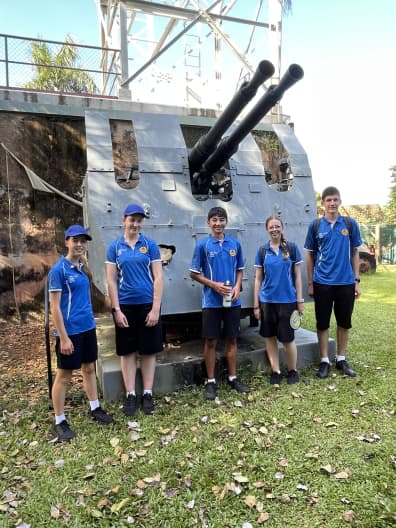 After a quick recharge at the hotel for lunch and an afternoon siesta, we were back on the coach for an exclusive evening experience at the Darwin Military Museum. There, we met Dr Norman Cramp, who provided us with a wonderful retelling of Darwin in the 1940s, combining everything we had learnt with John into an easy-to-visualise history lesson.
The museum itself was a multifaceted treasure trove, with exhibits ranging from wartime weaponry to an expansive Holocaust reflection centre, as well as a beautifully produced Darwin Bombing film that fully rounded out an information-packed day.
For me, the icing on the cake was discovering a museum exhibit dedicated exclusively to the soldier I have been researching, Navy Private Paton Forster, an artist who sketched scenes from the bombings. The display featured some of his artwork and included an audio recording of an interview with Pat. Hearing his voice describe the experiences I have been researching over the past few weeks was something I never expected to be possible, and I was incredibly grateful for the opportunity to listen.
Afterwards, we gathered with our guides to eat pizza and talk about the day, picking up souvenirs and taking a final look around. We headed home past a lovely Darwin sunset, pleased with how the day turned out and more than ready for bed.
My favourite part of the day was the museum at the end, made even better by having it all to ourselves during an exclusive after-hours experience. I think we all grew much closer today and worked really well together as a group. I cannot wait to continue tomorrow.
Day 1 by Mikaela Phin, Year 10, Busselton Senior High School and Adelle Hoddy, Year 11, Western Australian College of Agriculture - Cunderdin.
Today, the 10th of April 2026, marked the beginning of the 2026 Premier’s Anzac Tour. Ten students from across WA were selected to travel to both Singapore and Darwin to commemorate and acknowledge those who had fought in WWI, WWII and other peacekeeping missions and wars.
 We all nervously arrived at the Perth airport at the ripe hour of 5 am, preparing to board our flight to Darwin. We said our farewells to our parents and ended up at the back of a line of at least 100 people to drop off our baggage. The line moved fairly quickly, though, and before we knew it, we were on board the plane.
After what felt like 10 hours (but was really about 3 and a half), we arrived in Darwin. We grabbed our luggage and picked up our suitcases before heading out the door. The moment we stepped outside, the humidity hit us like a brick. The air was stiff and hot, the sun like a flame against our skin. Just a quick look around and you could instantly notice the difference between Perth and Darwin, it was like a tropical wonderland surrounding us! The air definitely had something different to it, a meaner tinge that was not often felt in the city of Perth. The plants were a beautiful green, it almost felt like we were in Singapore already!
We took a bus to our hotel and settled in before meeting downstairs and heading off on a walk just near the coast in beautiful gardens. We had some delicious lunch and stopped at a playground for a quick burst of energy to bring us back to life. We then picked up some snacks for ourselves before heading back to our rooms and taking a much-needed shower.
After we had some time to relax, we headed to have a Chinese dinner, the wonton soup being a very popular choice amongst us. We finally made it back to the hotel to settle down with a debrief of our day and a look at what tomorrow has in store.
Tour Participants
Students were selected as tour ambassadors following a written submission and interviews, demonstrating their interest in Australian history and an understanding of the Anzac legacy.
The 2026 Premier’s Anzac Student Tour participants are:
- Year 10 Lucy Henville, Mount Lawley Senior High School
- Year 10 Zach Lentin, Wesley College
- Year 10 Maya Gallegos, Collie Senior High School
- Year 10 Mikaela Phin, Busselton Senior High School
- Year 11 Adelle Hoddy, Western Australian College of Agriculture - Cunderdin
- Year 11 Henriette Hoger, Kolbe Catholic College
- Year 11 Josiah Simmons, Hedland Senior High School
- Year 11 Shylah Broux, Shenton College
- Year 12 Amy Newton-Norris, John Curtin College of the Arts
- Year 12 Bronte McGillivray, Lumen Christi College.