22 July 2025
The future now looks bright for Bunbury’s blue swimmer crabs thanks to the diligent work of local science students.
A bacterial crab shell disease outbreak in 2018 prompted biology students from Bunbury’s Manea Senior College to kick-off a research program to monitor the crustaceans.
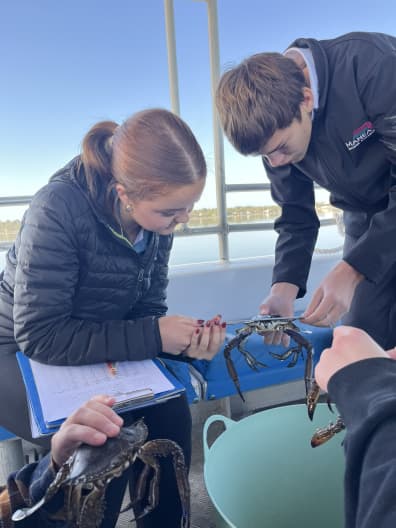
Manea Senior College students are helping monitor Bunbury’s blue swimmer crabs.
The project has now amassed eight years of data, a milestone the college’s science teacher and program coordinator, Lynette Hillier, believes will offer valuable insights into the health of Bunbury’s blue swimmer crab population.
“It generally takes at least five years of consistent monitoring to identify reliable trends and make meaningful comparisons across seasons,” she said.
“Weather conditions occasionally prevent us from collecting data, so having a longer dataset helps account for those gaps and build a clearer overall picture.
“During the eight-year period, several fishing regulation changes have been introduced. The extended timeframe now allows us to assess the potential impact of those changes on the crab population to better understand how the species is responding over time.”
Manea Senior College’s blue swimmer crab program began after Mrs Hillier asked Fisheries WA if they needed help to tackle the chitinoclastic shell disease outbreak. The disease decays shell chitin, causing lesions that make crabs vulnerable to infection.
“At the time, Fisheries were only conducting annual breeding stock surveys so I recognised a gap where students could contribute,” she said.
“We adopted the same scientific methods used by Fisheries to ensure our data was directly comparable, to support and complement existing research efforts into the underlying causes of the shell disease.”

Students measure the crabs they catch every three months.
The program began with eight pots and has since grown to 21, which are scattered throughout Bunbury’s Koombana Bay and Leschenault Estuary. With assistance from Southern Ports, Manea’s Year 11 and 12 biology students inspect the pots every three months and record their findings.
“Handling live crabs can initially be quite daunting but quickly becomes exciting and empowering,” Mrs Hillier said.
“Students build confidence, resilience, and teamwork skills as they work together to collect and record data.
“It’s definitely a highlight of their biology course.”
Students analyse the data to identify population trends and seasonal movement patterns of the blue swimmer crab population. They also explore differences in the male-to-female crab ratio by water depth, in both the estuary and bay.
Mrs Hillier said it was fulfilling to support the scientific understanding of Bunbury’s resident crustaceans while offering Manea Senior College students a valuable, hands-on learning experience.
“As a teacher, seeing students so actively engaged in science is incredibly rewarding,” she said.
“It reinforces the idea that learning isn’t confined to the classroom, and that students are capable of making real contributions to environmental research.
“The program helps students view science as an exciting and meaningful field, while also showing industry and the wider community that young people, when supported, can make important contributions to caring for the environment.”